
Physical Profile
Physical Profile Tanauan, Leyte. The municipality has a land area of 78.41 square kilometers or 30.27 square miles which constitutes 1.24% of Leyte’s total area. Its population as determined by the 2020 Census was 57,455. This represented 3.23% of the total population of Leyte province, or 1.26% of the overall population of the Eastern Visayas region. Based on these figures, the population density is computed at 733 inhabitants per square kilometer or 1,898 inhabitants per square mile.
Demographic Profile
| Year | Pop. | ±% p.a. |
|---|---|---|
| 1903 | 18,256 | — |
| 1918 | 18,880 | +0.22% |
| 1939 | 21,934 | +0.72% |
| 1948 | 24,573 | +1.27% |
| 1960 | 23,421 | −0.40% |
| 1970 | 29,438 | +2.31% |
| 1975 | 30,541 | +0.74% |
| 1980 | 31,487 | +0.61% |
| 1990 | 38,033 | +1.91% |
| 1995 | 40,716 | +1.29% |
| 2000 | 45,056 | +2.20% |
| 2007 | 47,426 | +0.71% |
| 2010 | 50,119 | +2.03% |
| 2015 | 55,021 | +1.79% |
| 2020 | 57,455 | +0.85% |
Socio-Economic Profile
In 2005, the municipality registered a total income of PHP 47.6 million. This went up to PHP 56.4 million in 2007, representing an average annual increase of over 9%, mostly coming from considerable increases in local taxes, permits and licenses, and the Internal Revenue Allotment. This economic performance was attributed largely to the reforms and initiatives introduced by Mayor Roque Tiu, which streamlined the processes of getting business and license permits.
As a result of these reforms, the municipality of Tanauan also earned the “2006 Most Business-Friendly Municipality in the Country” award during the closing rites of the 32nd Philippine Business Conference held at the Manila Hotel on October 20, 2006. Then President Gloria Arroyo handed the award to Mayor Tiu and his wife, PIA-8 Director Olive Tiu. Prior to winning the award, the municipality of Tanauan was also adjudged as the Most Business-Friendly Municipality in the Visayas Area.
The businesses and industries that support Tanauan’s local economy are from agriculture, livestock, fishing, forestry and mining, trade and industry, and tourism.
The major investors in the municipality are the following:
- Pepsi Cola (Tanauan plant)
- Wella Metal Corporation
- New Leyte Edible Oil Manufacturing Corporation
Languages
Waray-waray is the language spoken by the people of Tanauan. It is the lingua franca or common language of the Eastern Visayas region. However, Tagalog is widely understood and spoken by the locals when talking to other people coming from Manila and other Philippine provinces. English remains the language used by the local government and schools on official correspondences and documents. Waray-waray is used as a medium of instruction in schools in the municipality from Kindergarten to Grade 3. Filipino and English languages are officially taught in schools as part of the primary and secondary education curriculum requirement.
Religion
Tanauan has a 100% Christian population. Almost 96-97% of the municipality’s population are Roman Catholics. Every village has its own Roman Catholic chapel aside from the parish church in the town proper. There are also adherents of other Christian denominations and sects like the Iglesia ni Cristo, The Church of Jesus Christ of Latter-Day Saints (Mormons), Seventh-day Adventists (Sabadistas), Evangelicals (Born-Again Christians), Jehovah’s Witnesses (Mga Saksi ni Jehova) and many more.
The municipality’s patron saint is Our Lady of the Assumption (Nuestra Señora de la Asunción).
Local Industries and Crafts
Tanauan is known for various locally-made crafts, which include bamboo-craft, mat-weaving, bolos, brooms, hats, bricks, pottery, nipa shingles, and virgin coconut oil—most of which are made of local and indigenous materials. These trades have been the source of local pride, as by the brick and pottery makers of Barangay Canramos. Tanauan is also one of the best sources of clay in the region. These trades are mainly promoted by the Tanauan Women’s Club federation with the support of the municipal government.
Infrastructure
Storm Drainage System
Tanauan still lacks an efficient infrastructure for its storm drainage system. Although storm drainage projects were constructed in the past, it was poorly planned and maintained that resulted in a failure to prevent occasional flooding in various places within the town proper due to sedimentation and clogging of existing drainage canals.
Healthcare Facilities
Tanauan Birthing Facility. In 2009, Mayor Tiu constructed the birthing facility of Tanauan with assistance from the Japanese government. The project was funded through the Embassy of Japan’s Grant Assistance for Grassroots Human Security Projects (GGP), with a grant of US$62,135 (approximately 3 million pesos). The facility was turned over to the local government of Tanauan on April 27, 2010. The Embassy of Japan’s Minister for Economic Affairs, Tomochika Uyama, was present during the ceremony. The facility became operational in May 2010 and has since been providing appropriate and accessible medical services for pregnant women in Tanauan.
Utilities and Communications
The following are the telephone, mobile phone, and electric companies serving the area of Tanauan.
Telephone Companies:
- Bayan Telecommunications, Inc.
- Eastern Visayas Telephone Company
Mobile Phone Service Provider:
- Globe Telecom
- Smart Communications
- DITO
Electric Companies:
- Don Orestes Romualdez Electric Cooperative (DORELCO)
Water Supply:
- Leyte Metropolitan Water District (LMWD)
- Prime Water (PW)
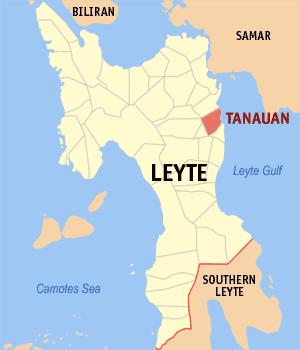
Tanauan, Leyte
The town has also been known as the “Cradle of Intellectuals”, or the Bungto han Kamag-araman, since the Spanish colonial era.
Parks and Playground
Tanauan currently has one large municipal plaza, which is located at the heart of the town across the back of the old municipal hall. It has a mini-amphitheater and large outdoor grounds, which is often used as a venue for large open-air activities such as the annual Pasaka Festival Competition among other outdoor gatherings of the town. It also has two outdoor basketball courts and one outdoor tennis court complex. Surrounding the plaza are various centuries-old acacia trees that are one of the most well-preserved in the Eastern Visayas Region.
Modes of Transportation
Tanauan is accessible mainly by land through public utility jeepneys. Taxis are also available from Tacloban City and the regional airport but generally have fares that cost higher. When travelling within Tanauan, pedicabs and tricycle cabs are available.
History
Tanauan, named after a molave tree lookout post, was settled by the Calanao and Siengco families in the 1600s. To protect against Moro pirates, they built a stone fortress in Buaya. Under Spanish rule, the first town officials were appointed in 1710, and Tolosa became a separate town in 1852.
During the American period, municipal governance continued until World War II, when the Japanese occupied Tanauan. The town was burned in 1943 and later liberated by Filipino and American forces in 1944. The U.S. Sixth Army established its headquarters there, constructing the Tanauan Airfield, which played a key role in the Philippine liberation. After the war, the airfield was abandoned, and the area became a commercial hub.
Post-war governance saw a succession of mayors, with major political shifts occurring during martial law and the EDSA Revolution. In the modern era, leaders like Roque Tiu, Agapito Pagayanan Jr., and Pelagio Tecson Jr. have shaped Tanauan’s development.
Education
Primary School/Elementary School
- Tanauan I Central School (Public)
- Tanauan II Central School (Public)
- Salvador Central School (Public)
Secondary School/High School
- Assumption Academy (Private)
- Kiling National High School (Public)
- Tanauan School of Craftsmanship and Home Industries (Public)
- Tanauan National High School (Public)
- Tanauan School of Arts and Trade (Public)
College/University
- Eastern Visayas State University – Tanauan Campus (Public)
Heritage and Culture
Local Cstoms and Etiquettes
Most locals take off their slippers, shoes, or flip flops before entering a house. During weddings, it is customary for the bride and groom to do the traditional folk dance called Kuratsa, and members of the family and guests alike are encouraged to pin money on their attire as a symbol of good luck and prosperity for the couple’s future. Tanauan-anons also observe fiesta celebrations annually in different barangays to honor their respective local Catholic saints. During the fiesta, it is a tradition to prepare food in every house and invite guests and visitors to share their meal as a sign of thanksgiving.
Church of Our Lady of the Assumption
The church is one of the six architectural heritage sites in Leyte. It was originally built by the Jesuit Missionaries in 1704 and was turned over to the Augustinians in the year 1768. Father Francisco de Paula Marquez spearheaded the repair and enlargement of the church from 1850 to 1860. He added a transept and constructed thick rock walls at the perimeter of the church with towers on each four corners for defense against pirates. The Church survived a hurricane and the storm surge of 1897. The Church takes pride of its Stations of the Cross made in Mexico using Spanish terracotta. The rectory and pulpit are also restored.
Pasaka Festival
The town’s Pasaka Festival started in 1991. The word “pasaka” means “assumption”, referring to the Virgin Mary’s assumption into heaven. The festival, which runs from August 1 to 15, is seen as an opportunity to showcase the town’s rich cultural heritage. It is a means of paying homage and thanksgiving to the town’s patroness, Our Lady of the Assumption. It begins with a nightly cultural presentation held from August 1 to 14 at the Tanauan Public Plaza, which showcases the best talents, culture, and tradition of the municipality, participated in by various schools, the local government unit, and non-government organizations of Tanauan.
In the afternoon of August 14, the traditional Pasaka Festival competition is held, which features a colorful presentation of a dance drama and street-dancing that depicts a community paying homage to the Blessed Virgin’s Assumption. The competition is grouped into three categories: the Senior category, participated in by high school students, and the Junior category, composed of elementary pupils and the general public of merry makers. The festival culminates on August 15, the Feast of the town’s patroness, and a Holy Mass celebrated at the Our Lady of the Assumption Parish Church. It is also observed as Tanauan Day, a local holiday.
Tinikling and its possible origins in Tanauan
Tinikling is the most popular and best-known of Philippine dances and honored as the Philippine national dance. It is one of the oldest Philippine traditional dances and originated in Leyte province. The people of Leyte describe the tikling bird, from which the tinikling dance got its name, as having one of the most unique movements—walking around and between tree branches and grass stems. Tinikling, the creative dance of Leyteños, imitate this bird’s movement through branches and stems with the use of bamboo poles.
In 2006, then-Mayor Tiu’s attention was called regarding the 2005 calendar of the Philippine National Oil Corporation entitled sulyap (glimpse), which highlighted looking back into the homes of Filipino culture and taking a glimpse into one’s roots in relation to moving forward in life. The second page of the calendar (March–April page) featured the Tinikling with this brief description in Filipino: …”ang Tinikling ay nagmula sa Tanauan, Leyte. Isa ito sa mga pinaka-kilalang Pilipinong sayaw sa buong mundo. Ang pagkamalikhain ng mga taga Leyte ay nagbigay buhay sa simpleng galaw ng ibong tikling, kung saan nakuhaang pangalan ng sayaw. Sa Tinikling naipamalas ang likas na halina at pagiging masayahin na nabubukod-tangi sa mga Pilipino.” Since then, the municipal government of Tanauan requested historians and enthusiasts of culture and the arts to shed light on the issue, so that the local government can initiate moves towards preserving the culture of the municipality. Tanauan has been called the “Cradle of Intellectuals” or “Bungto Han Kamag-araman” ever since the Spanish era. Another version of the story has it that the Tinikling originated in Tanauan, Leyte, but particularly in Barangay Kiling. The name “Kiling” is also derived from the tikling bird. This version of the story has yet to be authenticated. Today, pinpointing the exact origin of this dance still remains elusive.
Anthologist and poet Vicente I. De Veyra, a native of Leyte, collected folk songs in his book Mga Ambahan, which included one titled “Tinikling”.
Skimboarding
Tanauan is recognized as the “Skimboarding Capital of the Philippines”. It is told by oral tradition that skimboarding was first introduced in Tanauan in 2001, when a Palau national came to Tanauan to win the heart of a local lass. Since Tanauan is situated along the coast facing San Pedro Bay, the Palau national started making a skimboard. However, he was not able to teach the local youths how to use it since he needed to leave and go back to Palau. He left the skimboard, and the local youths started to train themselves on how to use it. Thereafter, young people from Barangay San Roque and Barangay Santo Niño started making prototypes of the skimboard which were then sold to enthusiasts. However, according to the locals, in the year December 1999 skimboarding was already being seen on Tanauan’s shore before the Palau national came to the town. They called it “sulinap”, using a plastic floater from a scrap of jetski, without knowing that the sport they were playing was called skimboarding. The first ride happened at “Air Waves”, now called as Sabang Surf Camp, in Dulag, Leyte. Darwin de Veyra Maceda was the first rider of “sulinap”, and he showed it to his brother Beben de Veyra Maceda. The two embraced the sport and started to teach the locals in Tanauan.
A contending tale has it that the first skimboarder in the Philippines, Michael Miranda, together with his friend Kim Ian “Dodot” Montaño, made the first locally-made skimboard, and with their enthusiasm for the sports introduced the skimboard and taught Tanauan locals how to ride it. The first skimboarding competition was organized by Darwin Maceda with his friends Alexander Cumpio and Nerizza Reynera at Tanauan’s Bantay Dagat area on March 31, 2002. Since then, skimboarding has spread to Tanauan’s nearby towns and later throughout the country. Currently, national and international skimboarding competitions are held annually at the Bantay Dagat area of Tanauan.